

AI AND COPYRIGHT – THE SHIFT FROM “PRECEDENT” TO “STANDARD”
VCI Legal – 26 May 2026
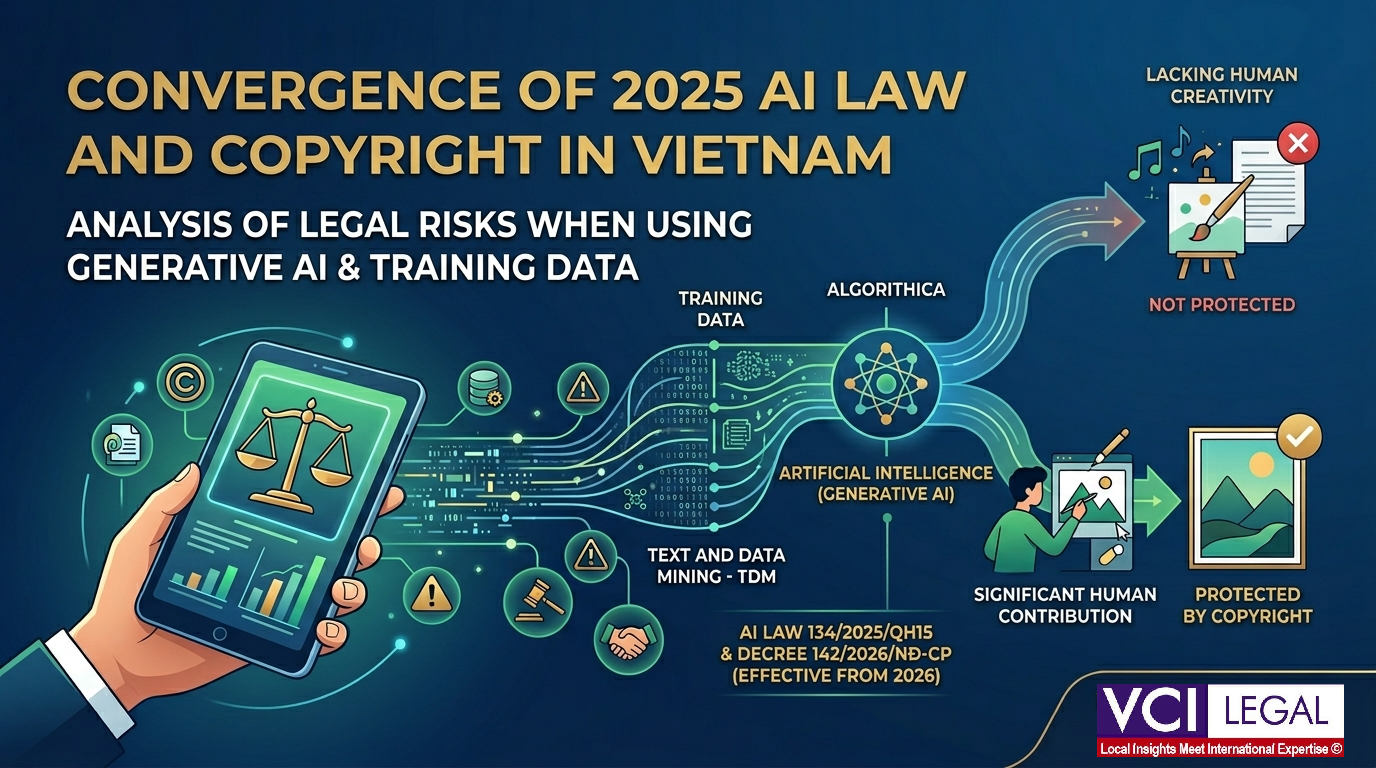
The introduction of the Law on Artificial Intelligence No. 134/2025/QH15 (officially effective from March 1, 2026) and Decree 142/2026/ND-CP not only establishes a technology risk control corridor but also triggers a wave of fierce debate on the boundaries of intellectual property protection. In the context of the explosion of generative AI models, the regulations on new technologies and copyright are becoming the hottest legal spotlight in Vietnam.
According to Vietnamese law, specifically the Law on Intellectual Property 2005 (amended and supplemented in 2025), the basic principle always affirms: only people (actual individuals) who directly create works are recognized as authors (Article 12a). Machines, algorithms, or any self-learning AI systems do not have independent legal status to register copyrights.
This compatibility is clearly demonstrated through two groups of works:
- AI-generated work: When the user only enters a simple prompt, and the AI automatically produces a picture, a piece of music, or a text. Due to the absence of direct creative intervention by humans, these works are at high risk of not being protected by copyright in Vietnam and will become public property. If copied by competitors, it will be extremely difficult for businesses to sue.
- AI-assisted work: If humans use AI as an assistive tool (similar to a brush or camera) and make a significant intellectual contribution to the final result through editing, collage, layering, or deep editing. Direct human creation will still be considered for protection.
Countries around the world also tend to receive this. In the US (Zarya of the Dawn Case – 2022): The US Copyright Office (USCO) has refused to protect the comic image created by AI Midjourney, only recognizing the text and layout made by Kristina Kashtanova herself. In Australia (Thaler v. Commissioner of Patents Case): The Federal Court of Australia affirmed that AI systems cannot be recognized as inventors or rights holders under current law.
One of the breakthroughs and also the source of the biggest legal debates in Vietnam today lies in this provision which introduces the concept of “Text and Data Mining Exception” (TDM) for AI training in the Intellectual Property Law (amended at the end of 2025)[1] effective from April 1, 2026.
The new regulation allows organizations and individuals to freely use documents and data on intellectual property rights that have been legally published and accessible to the public for scientific research, testing and training of AI systems without having to ask for permission or pay fees to rights holders. as long as:
- Do not unreasonably affect the legitimate rights and interests of authors and owners.
- The input data must be “legal” (with a clear origin, not copyright infringement data such as pirated films and books).
- Use only for research, testing and training purposes; Direct commercial use (e.g. resale of data) is not covered by this exception.
However, this regulation has caused the community of painters, musicians and writers in Vietnam to express deep concern. They argue that this regulation can be abused to allow tech companies to freely “scrape” all an artist’s intellectual property online to train commercial AI models without paying royalties.
Important legal notes for businesses: Although Clause 5, Article 7 has been passed, the law clearly stipulates that: for data that is subject to copyright protection, the exploitation must also comply with the Government’s regulations. As of mid-2026, the Government has not issued a legal document specifically guiding this TDM exception. So, in practical terms, this exception is not yet applicable. Any business that arbitrarily collects copyrighted data in Vietnam to train AI without permission still faces extremely serious legal risks.
Although no direct lawsuit about AI copyright infringement has been brought to trial in Vietnam, in fact, state management agencies are aggressively handling copyright infringement in the digital space.
In May 2026, the Ministry of Public Security (Police Department for Investigation of Corruption, Economic and Smuggling Crimes – C03) officially prosecuted 5 criminal cases for the act of “Infringement of copyright and related rights” that occurred at many businesses operating in the field of digital content. The defendants prosecuted include influential figures:
- Defendant Nguyen Hai Binh (General Director of BH Media Company): This unit has been involved in many scandals when arbitrarily “hitting the copyright stick” of public works such as the National Anthem. Mr. Binh has admitted to the act of arbitrarily using musical works to profit from advertising on YouTube without asking permission, do not pay royalties to the author.
- Defendant Diep Van Lap (i.e. bolero singer Quang Lap, running the Voice for Life Center): Prosecuted together with the leaders of other entertainment units such as Saigon May, Lululola Entertainment for similar violations in cyberspace.[2]
The case of BH Media and singer Quang Lap is a stern warning that: Copyright infringement in digital space is no longer a mere civil dispute but will be severely criminally handled.
AI development companies need to be well aware: If they illegally collect millions of musicals, painting, and literary works of Vietnamese artists to load into the AI system without a license contract to use the works, they can be criminally prosecuted for the same crime. “AI training” is not a shield to help businesses avoid the responsibility of protecting intellectual property.
In addition to specialized obligations regarding AI, Article 10a of Decree 100/2026/ND-CP establishes the criterion of “significant human creative contribution” as a mandatory threshold condition for copyright protection of a work. To meet this requirement, individuals must demonstrate that they have:
- Identified the specific technical problem and formed the foundational creative idea of the work;
- Actively established input parameters, instead of relying on general AI prompts; and;
- Evaluated, refined, and substantively transformed the AI-generated output to create a clearly original result.
From a legal perspective, this provision codifies a qualitative, rather than purely formal, evaluation standard. The focus of the examination is not on the use of AI tools, but on the nature and extent of the intellectual contribution of the operator. In this respect, the Decree places Vietnam within the mainstream of emerging international trends in the field of copyright protection related to AI, while maintaining academic consistency with the traditional concept of authorship.
The intersection between the Law on Artificial Intelligence 2025 and the Law on Intellectual Property is reshaping the entire creative economy in Vietnam. Proactively adapting, respecting artistic copyright and technology transparency are the golden keys to helping businesses develop sustainably in the digital era.
Strategic recommendations for businesses
To protect themselves against legal risks and AI-related intellectual property disputes in 2026, entities need to implement the following measures:
- For AI Developers
- Audit training data sources
- Respect the author’s right to “Opt-out”
- Compliance with AI labeling regulations under Article 11 of the Law on Artificial Intelligence 2025:
– Obligation of technical marking and AI content labeling
– Obligation of incident reporting and handling within 72 hours
– Three levels of AI system risk classification
– Conformity assessment procedures for high-risk artificial intelligence systems
– Conduct a conformity assessment
– Publicize the evaluation results
– Controlled testing mechanism (Sandbox mechanism)
- For Businesses applying AI and Creators
- Maintain complete documentation showing the human involvement in the creative process;
- Clearly record the data selection, parameter setting, and refinement process of the AI-generated results;
- Verify the legitimacy of the input data used to train or operate the AI;
- Establish a clear agreement between the business, personnel, and the AI system development unit regarding ownership rights over the generated results;
- Proactively register industrial property rights early to avoid the risk of copying or disputes over priority rights.
#ArtificialIntellectualPropertyLaw #Copyright #AIAct #DigitalTransformation
————–
[1] 1 Clause 5, Article 7 of the amended Intellectual Property Law 2025.
[2] https://thanhnien.vn/khoi-to-ca-si-quang-lap-va-nhieu-giam-doc-185260516114233055.htm.
About VCI Legal:
VCI Legal is an award-winning business law firm in Vietnam with a wide range of legal and corporate services, among other things, corporate, banking & finance, tax, labor & HR, real estate and dispute resolution with special focus on international investment disputes, We also offer our specialized type of service called “In-House Counsel Service” with the aim of assisting our clients in dealing with all types of internal and external issues arising from their day-to-day operations and business activities. With our offices in both Hanoi and Ho Chi Minh City, we have a tremendous depth of experience in providing well-reasoned and comprehensive legal advice to not only multinationals and Fortune 500 companies, but also small and medium enterprises.
Our professional team comprises one of the leading law firms in Vietnam with service quality highly recommended and acknowledged by international legal service reviewers such as: The Legal 500, AsiaLaw Profiles, IFLR, KPMG’s Tax Directors’ Handbook, Acquisition International, ACQ Global, Global Law Experts, Finance Monthly, and Chambers & Partners.
For many years, VCI Legal has been ranked among the top law firms in Vietnam for corporate, finance, insurance, taxation, employment, intellectual property and investment. With a “Can Do Attitude” combined with a “Know How” capacity, our firm is big enough to provide comprehensive legal support for any in-house legal matters, yet small enough to care about each of our clients. We undertake each engagement with the mindset of a long-term relationship, with the will to give whatever it takes to understand and fulfill your needs.
Ho Chi Minh City
Suite P7-42.18, Vinhomes Central Park, 720A Dien Bien Phu, Thanh My Tay Ward, Ho Chi Minh City, Vietnam
Tel.: (+84) 028 3827 2029 Fax: (+84) 028 3823 4436
Hanoi
Suite 1903, Floor 19, W1 Tower, Vinhomes Westpoint, Pham Hung, Tu Liem Ward, Hanoi City, Vietnam
Tel.: (+84) 024 3936 4985 – (+84) 024 3936 4987
Affiliated Offices: Beijing – Shanghai – Hanoi – Ho Chi Minh City – Singapore – New Delhi – Dubai – Doha – Zurich – Paris – Rome – Brescia – Washington D.C. – Los Angeles


