

THE NEW U.S. POLICY AND ITS IMPLICATIONS FOR AI GOVERNANCE IN VIETNAM, THE EU AND ASIA
VCI Legal – 5 October 2026
On 29 September 2026, President Donald J. Trump signed Executive Order 14434, Inaugurating the Era of Super Intelligence (the “Executive Order”), directing the U.S. executive branch to use the terms “Super Intelligence” (“SI”) and “SI” in place of “Artificial Intelligence” (“AI”) and “AI” in official communications and other non-statutory documents. On the same day, the White House and executives of Google, Anthropic, Meta, OpenAI, xAI and Nvidia signed the White House Accord on Super Intelligence – Joint Commitment on Frontier Responsibilities (the “White House Accord”).
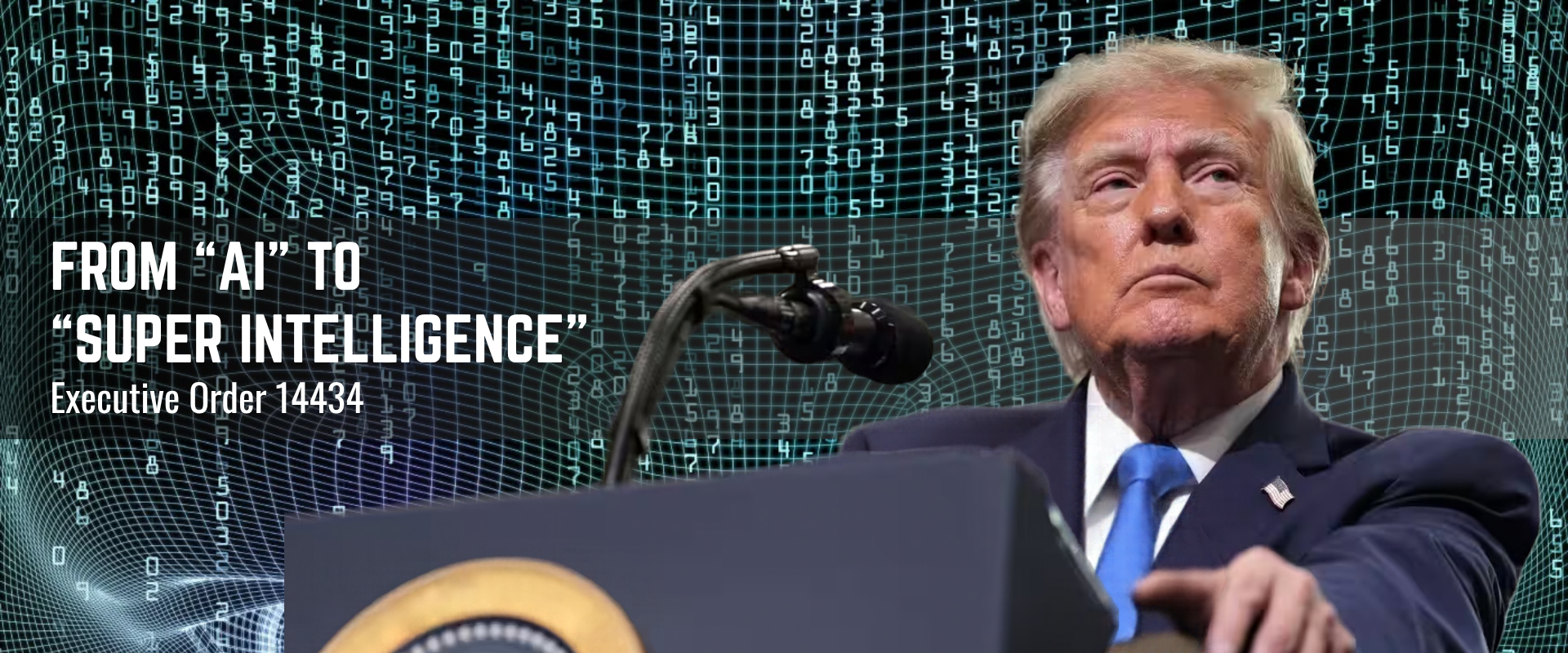
The Executive Order does not, by itself, establish a new substantive regulatory regime for private AI companies. For the time being, “Super Intelligence” under the Executive Order is defined by reference to the existing statutory U.S. definition of “artificial intelligence.” The Executive Order instead instructs the Assistant to the President for Science and Technology to prepare, within 60 days, proposed legislative language for a federal definition of SI and to assess whether that new definition should modify or supersede the existing statutory definition of AI.
The White House Accord is more significant from a corporate governance perspective. It establishes four layers of controls for companies developing and deploying frontier models: (1) robust internal controls during training and deployment; (2) an empowered internal team responsible for monitoring and remediation; (3) independent external audit or evaluation; and (4) an independent board committee responsible for overseeing the control framework and ensuring remediation of identified issues. The participating companies also undertake to meet regularly to develop standards and best practices, while expressly recognising that these measures may ultimately be codified into laws or regulations.
The immediate legal consequence outside the United States is limited. Their broader importance lies elsewhere: they provide evidence of an emerging international governance model in which model testing, internal accountability, independent assurance, board-level oversight and incident management increasingly operate as the core controls for advanced AI. The major difference between jurisdictions is no longer necessarily what risks should be controlled, but how legally binding those controls are.
- THE UNITED STATES: A MOVE TOWARDS COMPANY-LED GOVERNANCE, NOT YET A NEW COMPREHENSIVE AI LAW
The Executive Order represents a significant policy and terminology shift, but its immediate regulatory effect should not be overstated. Section 2(a) requires U.S. executive departments and agencies to replace “AI” terminology with “SI” in official correspondence, websites, reports, policy documents and other non-statutory materials. Section 2(b), however, expressly provides that previously issued regulations, Presidential actions, contracts, grants and historical documents do not need to be amended.
More importantly, Section 3(a) does not presently create a technically distinct category of “superintelligence”. Instead, it incorporates the existing definition of AI under 15 U.S.C. § 9401(3). Accordingly, at least until Congress or subsequent Presidential action establishes otherwise, “SI” is principally a new federal policy label rather than a separate legal category defined by a particular compute threshold, capability benchmark or autonomous decision-making capacity.
The White House Accord is different. Its focus is not terminology but corporate assurance architecture. The four-layer model moves responsibility progressively from technical controls, to an internal control function, to independent external assurance, and finally to the board of directors. Yet the Accord itself contemplates that these requirements might be codified in the future. It therefore operates presently as a company commitment and governance benchmark rather than as a generally applicable federal statutory compliance regime.
This distinction is particularly important for multinational technology companies. Compliance with the White House Accord should not be viewed as a regulatory passport. A company may satisfy the four voluntary layers in the United States and still be subject to substantially more detailed statutory requirements in Vietnam, the EU, South Korea or China.
- VIETNAM: SIMILAR GOVERNANCE OBJECTIVES, BUT ALREADY BACKED BY BINDING OBLIGATIONS
Vietnam has moved considerably further towards statutory AI governance. Law No. 134/2025/QH15 on Artificial Intelligence (the “AI Law”), effective from 1 March 2026, adopts a risk-based regulatory framework applicable not only to Vietnamese entities but also to foreign organisations and individuals involved in AI activities in Vietnam.
Unlike the White House Accord, however, Vietnam does not presently regulate “frontier models” as a stand-alone legal category. The AI Law classifies AI systems into high-risk, medium-risk and low-risk categories. Decree No. 142/2026/NĐ-CP further clarifies that the risk classification mechanism generally applies to AI systems rather than AI models as such, except where a model is used as a component of a particular AI system. This difference could become increasingly important if international regulation shifts towards direct supervision of frontier foundation models based on their underlying capabilities or computational scale.
For high-risk AI systems, the substantive overlap with the White House Accord is nevertheless substantial. Article 14.1 of the AI Law requires providers to establish and maintain risk-management measures, manage training and testing data, maintain technical documentation and operational logs, enable human supervision and intervention, meet transparency and incident-management requirements, and remain accountable to competent authorities. Deployers are separately required to supervise operation, maintain the possibility of human intervention, control risks and cooperate in incident remediation.
Decree 142 develops this framework further. Article 15 requires high-risk providers to maintain a risk-management system appropriate to the system’s intended purpose, deployment scope and risk level, including identification and assessment of risks to human rights, safety, security and public interests. Deployers must monitor operational performance, detect errors and emerging risks, maintain human oversight and intervention mechanisms and take mitigation measures when new risks arise.
The White House Accord’s third layer – independent external evaluation, also has a partial counterpart in Vietnamese law, but with an important difference. Under Article 13.2(a) of the AI Law, certain high-risk systems identified as requiring mandatory certification must be assessed by a registered or recognised conformity assessment organisation before being placed into service. For other high-risk systems, providers may conduct the conformity assessment themselves or engage an eligible conformity assessment body. Article 13.5 requires assessment bodies to be independent and technically competent. Decree 142 further requires such bodies to ensure independence and objectivity and to possess appropriate AI, cybersecurity and data-governance expertise.
Accordingly, an independent audit performed for purposes of the White House Accord would not automatically satisfy Vietnam’s conformity assessment requirements. Whether a foreign assessment can be relied upon will depend on the Vietnamese rules governing recognition of foreign conformity assessment results and whether the relevant assessment actually covers the requirements of the AI Law and Decree 142.

Vietnam has also gone beyond the Accord by imposing concrete incident-reporting obligations. Article 12 of the AI Law requires developers and providers to take urgent technical measures to remediate, suspend or recall systems following serious incidents, while deployers and users must record, notify and cooperate in remediation. Under Article 19.3(a) of Decree 142, specified emergency serious incidents must be preliminarily reported within 72 hours of confirmation; other serious incidents must generally be reported within five working days.
The Accord’s fourth layer, an independent committee of the board, does not presently have a direct equivalent requiring Vietnamese AI companies generally to establish a dedicated AI board committee. Nevertheless, the combination of statutory accountability, human oversight, risk management, documentation, post-deployment supervision and potential civil liability means that board-level governance is increasingly difficult to treat as merely optional corporate housekeeping.
For foreign providers, the point is particularly significant. Article 14.6 of the AI Law requires a foreign provider supplying a high-risk AI system for use in Vietnam to maintain a lawful contact in Vietnam and, where mandatory conformity certification applies, to maintain a commercial presence or authorised representative in Vietnam.
Vietnamese liability rules also make operational governance commercially important. Under Article 29.2 of the AI Law, where a high-risk AI system has been managed and operated in accordance with regulatory requirements but nevertheless causes damage, the deployer remains responsible for compensating the injured party, subject to its contractual ability to seek reimbursement from providers, developers or other relevant parties. Contractual allocation of AI risk between model providers, solution providers and deployers will therefore become as important as technical compliance itself.
There is also an immediate timing issue. AI systems already operating before 1 March 2026 are subject to transitional compliance periods. Under Article 35.1 of the AI Law, systems in healthcare, education and finance have 18 months from the Law’s effective date to comply, while other existing systems generally have 12 months. As of October 2026, businesses relying on legacy AI systems should therefore already be conducting classification, compliance-gap and remediation exercises rather than waiting for the transitional period to expire.
- THE EUROPEAN UNION: THE WHITE HOUSE MODEL ALREADY LOOKS FAMILIAR
The strongest comparison with the White House Accord is found in the EU Artificial Intelligence Act, particularly its regime for general-purpose AI (“GPAI”) models with systemic risk.
Article 51 of Regulation (EU) 2024/1689 classifies a GPAI model as presenting systemic risk where it possesses high-impact capabilities or is designated by the European Commission on equivalent grounds. Article 51.2 creates a presumption of high-impact capability where the cumulative computation used for training exceeds 10^25 floating-point operations.
For such models, Article 55.1 requires providers to perform and document model evaluations and adversarial testing, assess and mitigate systemic risks at EU level, track and report serious incidents and corrective measures, and maintain adequate cybersecurity protection for both the model and its physical infrastructure.
The resemblance to the White House Accord is striking. The U.S. Accord speaks of monitoring model capabilities and alignment, cybersecurity, biosecurity and chemical threats; independent evaluation; remediation; and governance oversight. The EU has converted several of these same concepts into express legal duties.
The EU regime also contains broader organisational-governance requirements. For high-risk AI systems, Article 17.1 of the AI Act requires providers to establish a documented quality-management system encompassing design verification, development and quality assurance, testing and validation, risk management, post-market monitoring, incident-reporting procedures and record keeping. Article 17.1(m) specifically requires an accountability framework defining the responsibilities of management and other staff. Article 72 separately requires active and systematic post-market monitoring throughout the system’s lifetime.
The important difference is enforceability. Since 2 August 2026, the AI Office’s enforcement powers apply to the GPAI regime, including the security and safety obligations applicable to the most advanced models. Breaches of GPAI obligations may result in penalties of up to EUR 15 million or 3% of worldwide annual turnover, subject to the applicable provisions and circumstances.
The White House Accord therefore does not represent an entirely new governance architecture from the EU perspective. Rather, it suggests increasing convergence between major technology companies and EU regulators on the need for model evaluation, safety controls and organisational accountability, while the United States currently relies to a much greater degree on corporate commitments.
- ASIA: COMMON SAFETY PRINCIPLES, VERY DIFFERENT REGULATORY METHODS
There is no single “Asian approach” to AI regulation. South Korea, Singapore, China and Japan illustrate four substantially different regulatory models.
South Korea is moving closest to a statutory frontier-model safety regime. Article 32.1 of its AI Basic Act requires AI business operators whose systems exceed the computational threshold prescribed by Presidential Decree to identify, evaluate and mitigate risks throughout the AI lifecycle and to establish a risk-management system capable of monitoring and responding to AI safety incidents. Article 24.1 of the Enforcement Decree applies the requirement where all specified conditions are satisfied, including cumulative training computation of at least 10^26 floating-point operations, use of state-of-the-art AI technology, and a risk of broad and serious impact on human life, physical safety or fundamental rights.
South Korea therefore does something neither the White House Accord nor Vietnam’s current AI Law does expressly: it links advanced-model safety obligations to a statutory computational threshold and frontier technological characteristics. In addition, Articles 31 and 34 of the AI Basic Act impose transparency requirements for generative and high-impact AI and require measures including risk-management arrangements, human management and supervision, documentation and user-protection mechanisms for high-impact AI.
Singapore remains closer to the governance philosophy reflected in the White House Accord. Its Model AI Governance Framework for Generative AI is principally a soft-law governance framework rather than a comprehensive binding AI statute. Its nine governance dimensions include incident reporting, testing and assurance through third-party testing, security, accountability and trusted development and deployment. In particular, its “Testing and Assurance” dimension explicitly identifies external validation and third-party testing as a means of generating additional trust.This makes Singapore conceptually one of the closest Asian comparators to the White House model of industry-led assurance, while retaining Singapore’s broader emphasis on practical and interoperable governance.
China follows a more interventionist administrative model. Under the Interim Measures for the Management of Generative Artificial Intelligence Services, providers must address unlawful content, retain relevant records and report specified matters to competent authorities. Article 17 further requires providers of generative AI services possessing public-opinion attributes or social-mobilisation capabilities to conduct security assessments and complete algorithm filing procedures in accordance with the applicable algorithm-regulation framework. The focus is therefore less on voluntary board-level assurance and more on provider responsibility, administrative supervision, content governance and security control.
Japan takes a comparatively principles-based and agile-governance approach. Act No. 53 of 2025 on the Promotion of Research and Development and Utilization of Artificial Intelligence-related Technology obliges business operators to cooperate with government AI measures, while Article 13 instructs the Government to establish guidelines consistent with international norms to ensure appropriate AI research, development and use. Article 16 provides for government collection and analysis of AI developments and harmful cases and for resulting guidance, advice and information to operators. Japan’s implementing guideline expressly seeks to encourage voluntary and proactive stakeholder action, taking account of organisational size, role and AI risk. In regulatory philosophy, Japan and Singapore therefore sit closer to the White House Accord than the EU, Vietnam or South Korea, although the surrounding legal systems continue to apply to AI-related conduct.
- WHAT THIS MEANS FOR BUSINESSES OPERATING IN VIETNAM
The central lesson is that the White House Accord should be treated as a governance baseline, not a compliance ceiling.
For multinational technology businesses, maintaining completely separate AI-control systems for each jurisdiction will become increasingly inefficient. The more sustainable approach is to establish a global AI-governance architecture capable of mapping a common set of controls, model evaluation, risk registers, testing, human oversight, incident response, independent assurance and management accountability, against the specific legal requirements of each jurisdiction.
For companies operating in Vietnam, however, a global corporate policy cannot replace statutory compliance. Providers and deployers should identify whether each deployed solution constitutes an AI system for Vietnamese regulatory purposes, determine the applicable risk classification, document the classification process, identify any notification or conformity-assessment requirement and establish an incident-response procedure capable of meeting the Vietnamese statutory deadlines.
Corporate groups using foreign-developed foundation models should also review their vendor arrangements. Contracts should allocate responsibility for technical documentation, testing information, incident notification, remediation assistance, audit cooperation, regulatory inquiries and liability allocation. This is particularly important where the Vietnamese entity is legally characterised as the deployer while the foreign group company or technology supplier is the provider or developer.
Finally, the White House Accord’s board-committee requirement should not be dismissed simply because Vietnam does not yet mandate an equivalent structure. The regulatory direction across the United States, the EU and Asia increasingly points towards identifiable senior-management responsibility for AI governance. For businesses deploying AI in material decision-making, critical systems or heavily regulated sectors, a board-level or senior-management AI oversight function is increasingly defensible as both a governance measure and an evidentiary mechanism for demonstrating reasonable control.
CONCLUSION
President Trump’s September 2026 initiative does not create a new global law of “Super Intelligence”. The Executive Order principally changes federal terminology and starts a process for developing a new federal definition. The White House Accord, meanwhile, establishes a voluntary corporate framework centred on internal controls, independent assurance and board oversight.
Its greater significance is therefore directional.
Across jurisdictions, the regulatory vocabulary differs, “Super Intelligence” in the new U.S. policy, “general-purpose AI models with systemic risk” in the EU, “high-risk AI systems” in Vietnam, computationally advanced systems in South Korea and generative AI governance frameworks elsewhere in Asia. Yet the underlying regulatory expectations are beginning to converge around a common proposition: the more capable and consequential an AI system becomes, the less acceptable it is for safety, testing and accountability to remain solely within the engineering team that created it.
For companies operating across borders, the next phase of AI compliance is therefore unlikely to be satisfied by a privacy policy, an AI-use policy or a single technical audit. It will increasingly require an integrated governance system connecting technical testing, corporate accountability, independent assurance, incident management and regulatory compliance across multiple jurisdictions.
Reference
- Executive Order 14434, Inaugurating the Era of Super Intelligence, 29 September 2026, Sections 1–3; White House Accord on Super Intelligence – Joint Commitment on Frontier Responsibilities, 29 September 2026, Sections 2(a)–2(b), 3(a)–3(b), 4(c), 15 U.S.C. § 9401(3)
- White House Accord on Super Intelligence – Joint Commitment on Frontier Responsibilities.
- Law No. 134/2025/QH15 on Artificial Intelligence dated 10 December 2025 (“Vietnam AI Law”).
- Government Decree No. 142/2026/NĐ-CP dated 30 April 2026, effective 1 May 2026 (“Decree 142”).
- Regulation (EU) 2024/1689 (Artificial Intelligence Act), Article 51.1(a)–(d), Article 51.2., Article 17.1(a)–(m), Articles 16(f), 43 and 72.1–72.3. Article 17.1(m)
- European Commission, The Enforcement Framework of the AI Act, updated 24 August 2026. The Commission states that AI Office and national-authority enforcement powers began applying from 2 August 2026, including GPAI obligations covering security and safety of advanced models; breaches of GPAI obligations may result in fines of up to EUR 15 million or 3% of worldwide annual turnover.
- Republic of Korea, Framework Act on the Development of Artificial Intelligence and Establishment of a Foundation for Trustworthiness, as amended by Act No. 21311 of 20 January 2026, effective 21 July 2026 (“Korea AI Basic Act”), Article 31.1–31.4, Article 32.1(1)–(2), Article 32.2–32.3, Article 34.1(1)–(5); Enforcement Decree of the AI Basic Act, Presidential Decree No. 36580, Article 24.1(1)–(3), effective 20 August 2026. Article 24.1 requires all three specified criteria, including at least 10^26 FLOPs of cumulative training computation.
- Singapore Infocomm Media Development Authority and AI Verify Foundation, Model AI Governance Framework for Generative AI (2024), Dimensions 1, 3, 4, 5 and 6.
- People’s Republic of China, Interim Measures for the Management of Generative Artificial Intelligence Services, Articles 14–17.
- Japan, Act on Promotion of Research and Development, and Utilization of Artificial Intelligence-related Technology, Act No. 53 of 2025, Articles 7, 13 and 16.
This Legal Briefing Note is provided for general information only and does not constitute legal advice.
About VCI Legal:
VCI Legal is an award-winning business law firm in Vietnam with a wide range of legal and corporate services, among other things, corporate, banking & finance, tax, labor & HR, real estate and dispute resolution with special focus on international investment disputes, We also offer our specialized type of service called “In-House Counsel Service” with the aim of assisting our clients in dealing with all types of internal and external issues arising from their day-to-day operations and business activities. With our offices in both Hanoi and Ho Chi Minh City, we have a tremendous depth of experience in providing well-reasoned and comprehensive legal advice to not only multinationals and Fortune 500 companies, but also small and medium enterprises.
Our professional team comprises one of the leading law firms in Vietnam with service quality highly recommended and acknowledged by international legal service reviewers such as: The Legal 500, AsiaLaw Profiles, IFLR, KPMG’s Tax Directors’ Handbook, Acquisition International, ACQ Global, Global Law Experts, Finance Monthly, and Chambers & Partners.
For many years, VCI Legal has been ranked among the top law firms in Vietnam for corporate, finance, insurance, taxation, employment, intellectual property and investment. With a “Can Do Attitude” combined with a “Know How” capacity, our firm is big enough to provide comprehensive legal support for any in-house legal matters, yet small enough to care about each of our clients. We undertake each engagement with the mindset of a long-term relationship, with the will to give whatever it takes to understand and fulfill your needs.
Ho Chi Minh City
Suite P7-42.18, Vinhomes Central Park, 720A Dien Bien Phu, Thanh My Tay Ward, Ho Chi Minh City, Vietnam
Tel.: (+84) 028 3827 2029 Fax: (+84) 028 3823 4436
Hanoi
Suite 1903, Floor 19, W1 Tower, Vinhomes Westpoint, Pham Hung, Tu Liem Ward, Hanoi City, Vietnam
Tel.: (+84) 024 3936 4985 – (+84) 024 3936 4987
Affiliated Offices: Beijing – Shanghai – Hanoi – Ho Chi Minh City – Singapore – New Delhi – Dubai – Doha – Zurich – Paris – Rome – Brescia – Washington D.C. – Los Angeles


