

INSTITUTIONAL TRUST AND LEGAL TRANSPARENCY KEY TO VIETNAM’S INTERNATIONAL FINANCIAL CENTRE DEVELOPMENT
VCI Legal – December 31, 2025
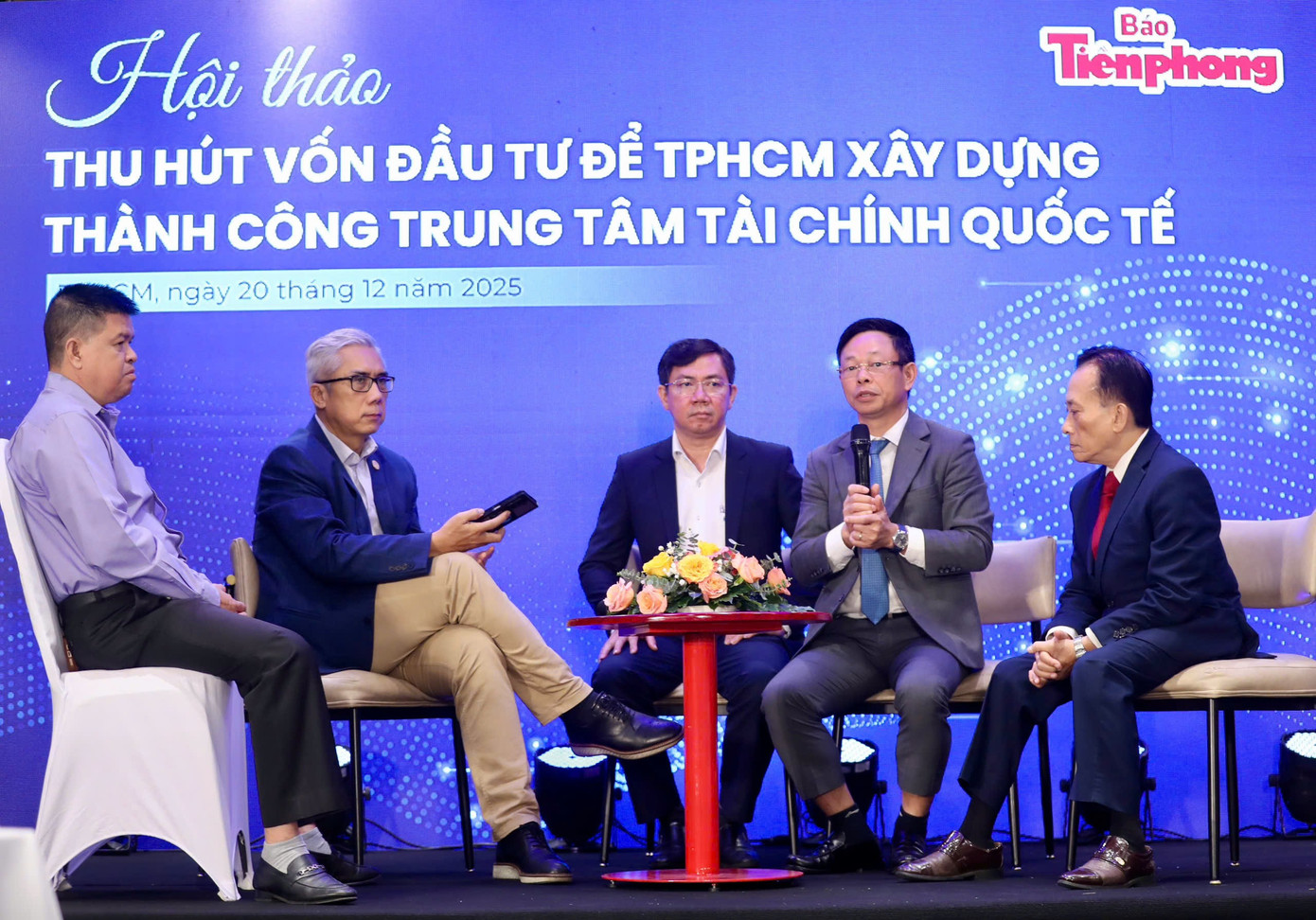
At the conference “Attracting Investment Capital for Ho Chi Minh City’s Successful Development of an International Financial Centre,” organized by Tien Phong Newspaper, Mr. Phung Anh Tuan – Secretary General of the Vietnam Association of Financial Investors (VAFI) and Member of the Executive Committee of the Vietnam Blockchain and Digital Assets Association – emphasized that building trust and ensuring transparency in the application of law are decisive factors for the sustainable development of an international financial centre.

Further elaborating on the decisive role of institutional reform, Mr. Phung Anh Tuan emphasized that the success of Vietnam’s International Financial Centre (IFC), particularly in Ho Chi Minh City, ultimately depends on the ability of the legal and regulatory framework to attract, deploy, and retain international capital in a predictable and internationally compatible manner.
Vietnam is entering a critical phase of development, with the National Assembly and Government setting ambitious growth targets of at least 8% in 2025 and double-digit growth during 2026–2030. However, traditional growth drivers—bank credit, public investment, and conventional FDI—are increasingly constrained. The scale of capital required for energy, infrastructure, urban development, and digital transformation is unprecedented, with energy infrastructure alone estimated to require over USD 136 billion by 2030. This reality underscores the urgent need for a deeper, broader, and more sophisticated capital market, of which the IFC is a central pillar.
Institutional Predictability and Legal Infrastructure
According to Mr. Tuan, institutional reform must go beyond policy statements and focus on legal predictability, transparency, and enforceability—three factors that international investors consider non-negotiable. While Vietnam has promulgated a wide range of laws governing investment and business activities, including the Law on Investment, Law on Enterprises, Land Law, Securities Law, tax regulations, and foreign exchange controls, fragmentation and inconsistency remain significant challenges.
The adoption of Resolution No. 222/2025/QH15 on the International Financial Centre, together with related implementing decrees, represents an important step forward. Notably, the proposed establishment of specialized IFC courts, operating in English and with the possibility of appointing foreign judges, sends a strong signal of Vietnam’s commitment to aligning with international dispute resolution standards. These mechanisms are essential to reducing perceived legal risks and enhancing investor confidence.
However, Mr. Tuan cautioned that institutional credibility will depend on how such mechanisms operate in practice. In particular, the provision allowing the application of foreign law “provided that it does not contravene the fundamental principles of Vietnamese law” must be clearly interpreted and narrowly defined. Without clear guidance, this clause risks undermining legal certainty and may deter sophisticated investors who require clarity on governing law and dispute resolution from the outset.
IFC as a Regulatory Sandbox and Innovation Platform
Drawing from international experience, Mr. Tuan highlighted that successful financial centres do not merely replicate existing legal frameworks; they function as regulatory laboratories that allow new financial products, technologies, and governance models to be tested under controlled conditions. In this regard, Vietnam’s IFC should be positioned not only as a financial hub, but also as a regulatory sandbox for capital markets, encompassing both traditional finance and emerging areas such as digital assets, tokenization, and fintech.
The presentation underscored that digital assets and tokenized real-world assets (RWA) are rapidly becoming a new channel for capital mobilization globally. Vietnam already demonstrates high levels of digital asset adoption, yet the legal framework governing virtual assets and related service providers remains incomplete. Current draft regulations primarily address fiat currency transactions and do not fully encompass digital assets, creating regulatory gaps and uncertainty.
Mr. Tuan argued that addressing these gaps within the IFC framework—through pilot decrees, risk-based supervision, and internationally aligned AML/CFT standards—would allow Vietnam to safely integrate digital finance into its capital markets. Such an approach would not only attract foreign fintech firms and institutional investors, but also strengthen Vietnam’s position in regional and global financial value chains.
From Administrative Control to Market Confidence
A recurring theme in Mr. Tuan’s remarks was the need for a fundamental shift in legislative and regulatory mindset. Rather than “regulating to control,” IFC institutions should be designed to regulate to enable, focusing on predictability, proportionality, and transparency. International investors assess not only the content of laws, but also their stability, consistency, and the capacity of institutions to implement them fairly and efficiently.
In this context, the IFC should serve as a model for institutional excellence, gradually diffusing best practices to the broader legal system. Measures such as a unified “one-stop” administrative mechanism, clear licensing criteria, transparent supervisory processes, and independent dispute resolution are essential to building long-term trust in Vietnam’s investment environment.
Human Capital and Soft Infrastructure
Beyond legal rules, Mr. Tuan stressed that institutional reform must also encompass soft infrastructure, including human capital, governance capacity, and inter-agency coordination. The ability to attract high-quality international talent—judges, regulators, financial experts, and technology specialists—is particularly critical during the early stages of IFC development. Flexible visa regimes, competitive tax policies, and an international-standard living and working environment are therefore integral components of institutional reform.
Conclusion: Institutional Reform as a Competitive Advantage
In conclusion, Mr. Phung Anh Tuan reaffirmed that institutional reform is not merely a supporting condition, but the core competitive advantage determining whether Vietnam’s IFC can succeed in an increasingly competitive global landscape. As a latecomer, Vietnam must benchmark itself against established financial centres such as London, New York, Hong Kong, and Tokyo, adopting internationally recognized standards while tailoring them to national priorities.
If designed and implemented effectively, the IFC can become a catalyst for broader institutional transformation—turning Vietnam’s legal and regulatory framework into a strategic asset that attracts global capital, fosters innovation, and supports sustainable long-term growth.
About VCI Legal:
VCI Legal is an award-winning business law firm in Vietnam with a wide range of legal and corporate services, among other things, corporate, banking & finance, tax, labor & HR, real estate and dispute resolution with special focus on international investment disputes, We also offer our specialized type of service called “In-House Counsel Service” with the aim of assisting our clients in dealing with all types of internal and external issues arising from their day-to-day operations and business activities. With our offices in both Hanoi and Ho Chi Minh City, we have a tremendous depth of experience in providing well-reasoned and comprehensive legal advice to not only multinationals and Fortune 500 companies, but also small and medium enterprises.
Our professional team comprises one of the leading law firms in Vietnam with service quality highly recommended and acknowledged by international legal service reviewers such as: The Legal 500, AsiaLaw Profiles, IFLR, KPMG’s Tax Directors’ Handbook, Acquisition International, ACQ Global, Global Law Experts, Finance Monthly, and Chambers & Partners.
For many years, VCI Legal has been ranked among the top law firms in Vietnam for corporate, finance, insurance, taxation, employment, intellectual property and investment. With a “Can Do Attitude” combined with a “Know How” capacity, our firm is big enough to provide comprehensive legal support for any in-house legal matters, yet small enough to care about each of our clients. We undertake each engagement with the mindset of a long-term relationship, with the will to give whatever it takes to understand and fulfill your needs.
Ho Chi Minh City
Suite P7-42.18, Vinhomes Central Park, 720A Dien Bien Phu, Thanh My Tay Ward, Ho Chi Minh City, Vietnam
Tel.: (+84) 028 3827 2029 Fax: (+84) 028 3823 4436
Hanoi
Suite 1903, Floor 19, W1 Tower, Vinhomes Westpoint, Pham Hung, Tu Liem Ward, Hanoi City, Vietnam
Tel.: (+84) 024 3936 4985 – (+84) 024 3936 4987
Affiliated Offices: Beijing – Shanghai – Hanoi – Ho Chi Minh City – Singapore – New Delhi – Dubai – Doha – Zurich Paris – Rome – Brescia – Washington D.C. – Los Angeles


